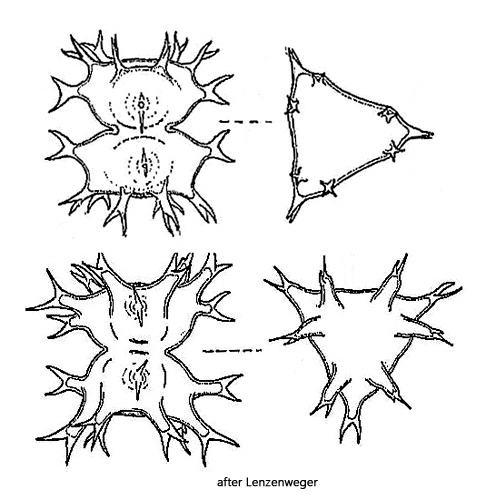
lateral angles with each on bifurcated spine, three per semi-cell
apical angles with each one bifurcate spine, six per semi-cell
length 23–30 µm, width 23–28 µm
cell wall smooth, rarely with fine granules
each semi-cell with one pyrenoid
Staurastrum furcatum
I have only found Staurastrum furcatum once in small numbers in samples from the Lauchsee Moor (Austria) in August 2025. Although the alga is quite small, it stands out when examining the samples due to the furctaed spines, of which 6 are located at each of the apical angles and three at each of the equatorial angles. Lenzenweger (1997) describes Staurastrum furcatum as quite variable.
The similar species Staurastrum aciculiferum has shorter projections, with the equatorial ones pointing in the apical direction, and Staurastrum senarium has 15 projections with spines per semicell instead of 9, as in Staurastrum furcatum.
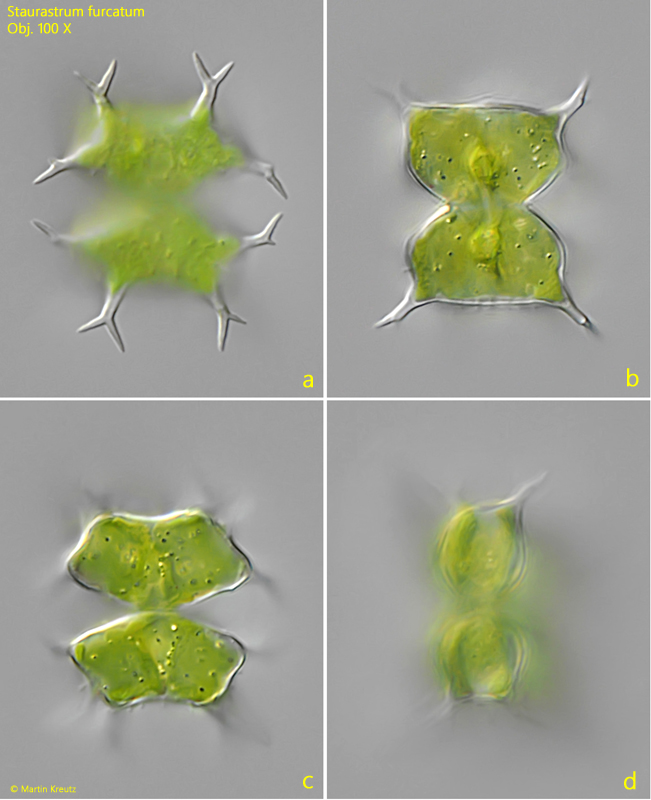
Fig. 1 a-d:Staurastrum furcatum. L = 36 µm. Four focal planes of a specimen in DIC. Obj. 100 X.
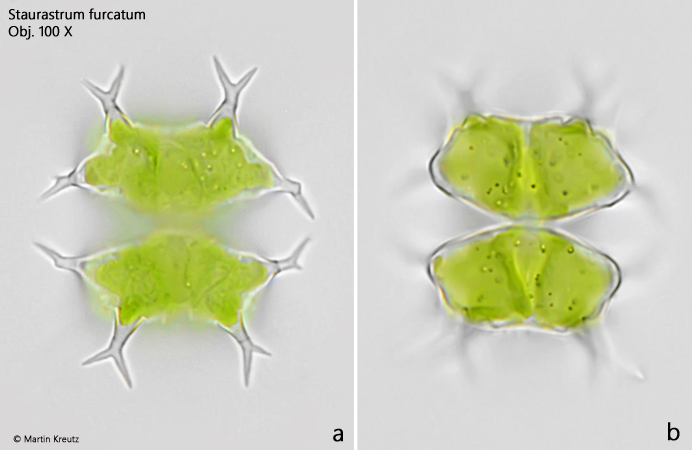
Fig. 2 a-b:Staurastrum furcatum. L = 36 µm. The same specimen as shown in fig. 1 a-d in brightfield illumination. Obj. 100 X.