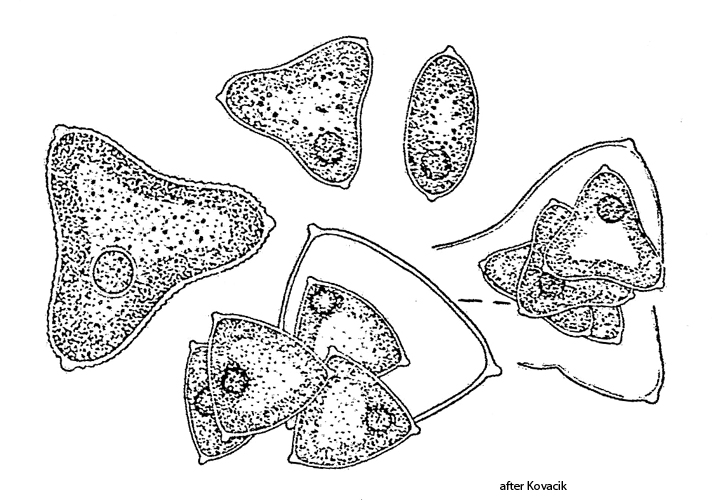
body triangular, cushion-shaped, corners with papillae
sides concave, rarely convex
cell wall warty or smooth
diameter 6–14 µm
one parietal chloroplast
one pyrenoid
asexual reproduction with 4 autospores
planctonic lifestyle
Tetraedron triangulare
So far I have only been able to find Tetraedron triangulare once, in September 2026 in the pond of St. Ulrich. There I did not find the specimens in the plankton, but in the detritus on the bottom of the pond. Presumably these were sunken specimens, since the alga is said to have a planktonic way of life.
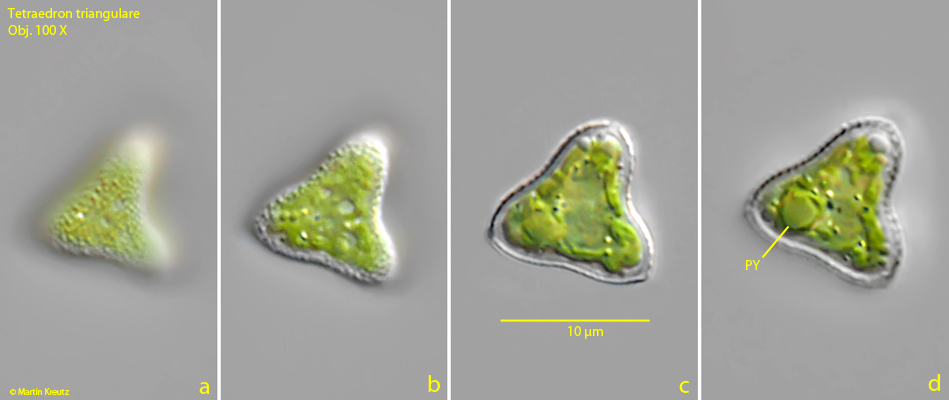
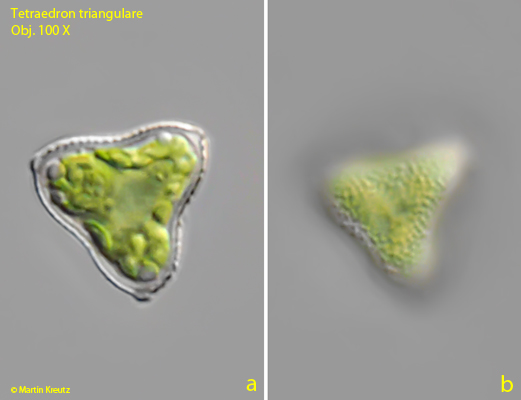
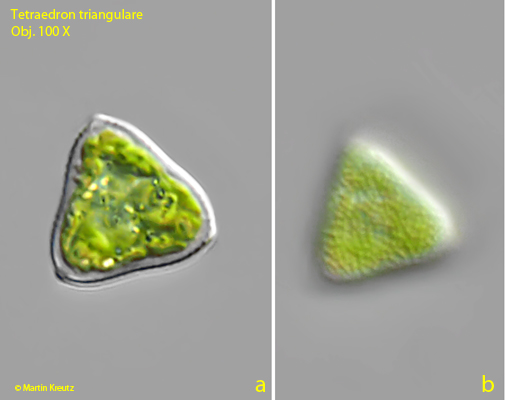
The specimens of my population had a diameter of 11–14 µm. Despite the small size, the alga can be easily identified due to its characteristic shape. At the three corners the cell wall is thickened in a papilla-like manner. In my specimens the sides were consistently concave, although they can sometimes also be convex. In my specimens the cell wall was always finely granulated (s. figs. 1 a and 2 b). In one specimen I had the impression that slight dimples were present (s. fig. 3b), but this is at the resolution limit of the light microscope.
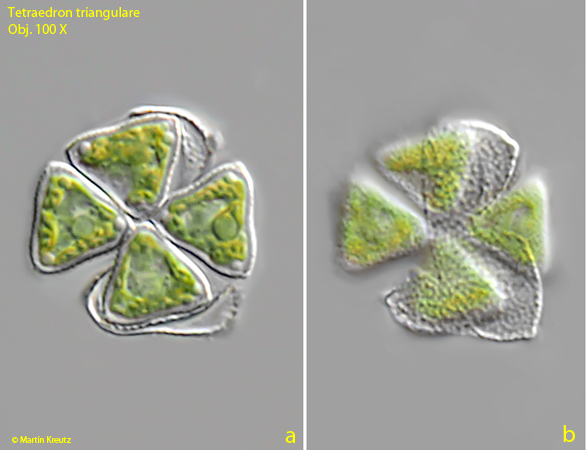
In one case I was able to observe reproduction by 4 autospores (s. fig. 4). In the mother cell, 4 daughter cells are formed through two successive cell divisions. Afterwards the cell wall of the mother cell tears open and the 4 daughter cells are released.
Due to its triangular shape and small size, Tetraedron triangulare can be confused with species of the genus Goniochloris, which belong to the Xanthophyceae. However, species of Goniochloris do not possess a pyrenoid and produce chrysolaminarin instead of starch. Moreover, they usually have several chloroplasts.
Fig. 1 a-d:Tetraedron triangulare. D = 12.4 µm. Different focal planes of a specimen found in September 2026 in the pond of St. Ultich. PY = pyrenoid. Obj. 100 X.
Fig. 2 a-b:Tetraedron triangulare. D = 13.4 µm. Two focal planes of a third specimen. Obj. 100 X.
Fig. 3 a-b:Tetraedron triangulare. D = 12.7 µm. Two focal planes of a second specimen. Obj. 100 X.
Fig. 4:Tetraedron triangulare. Four daughter cells are released from the mother cell. Obj. 100 X.