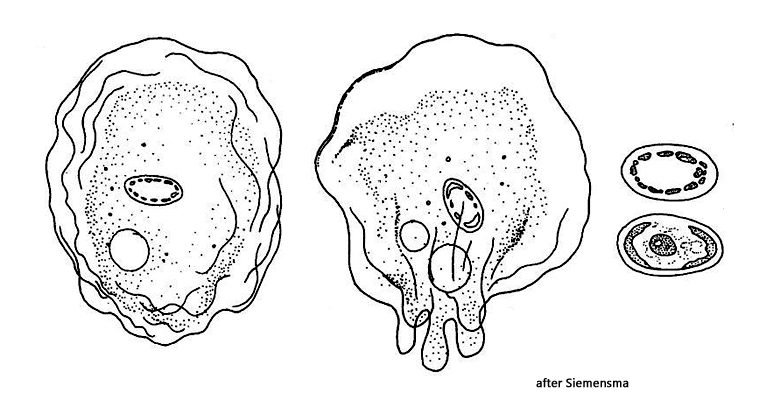
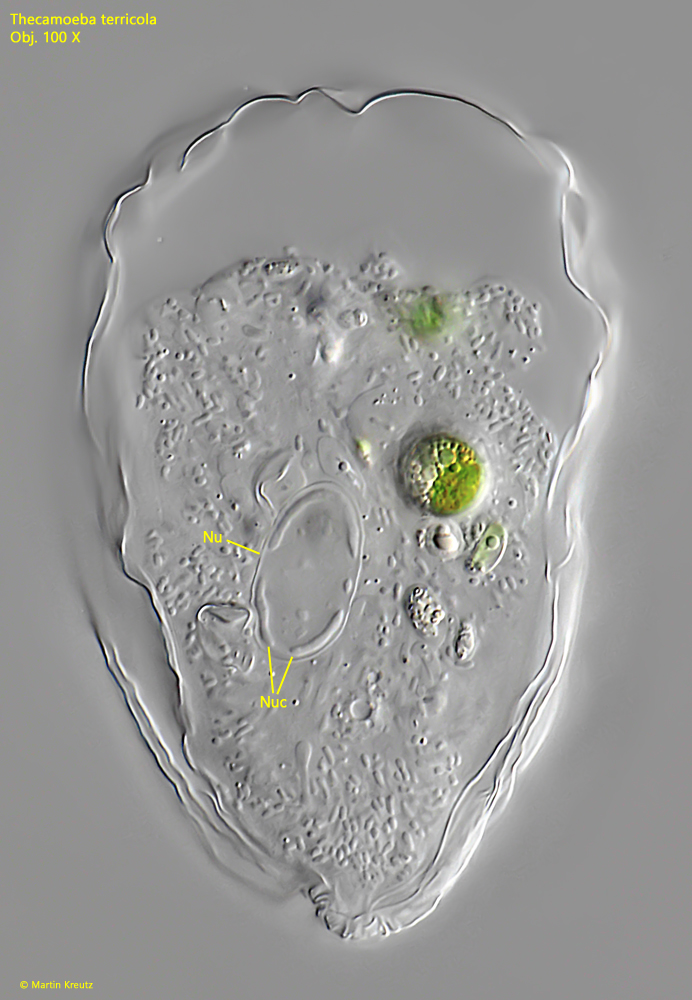
nucleus ellipsiod (14–31 µm) with parietal nucleolar bodies
one contractile vacuole
uroid strongly wrinkled, in parallel folds or with hyaline knobs
Thecamoeba terricola
I found Thecamoeba terricola in a moss sample that I had doused with tap water. After 2 weeks in a closed petri dish, a large population of Thecamoeba terricola had formed.
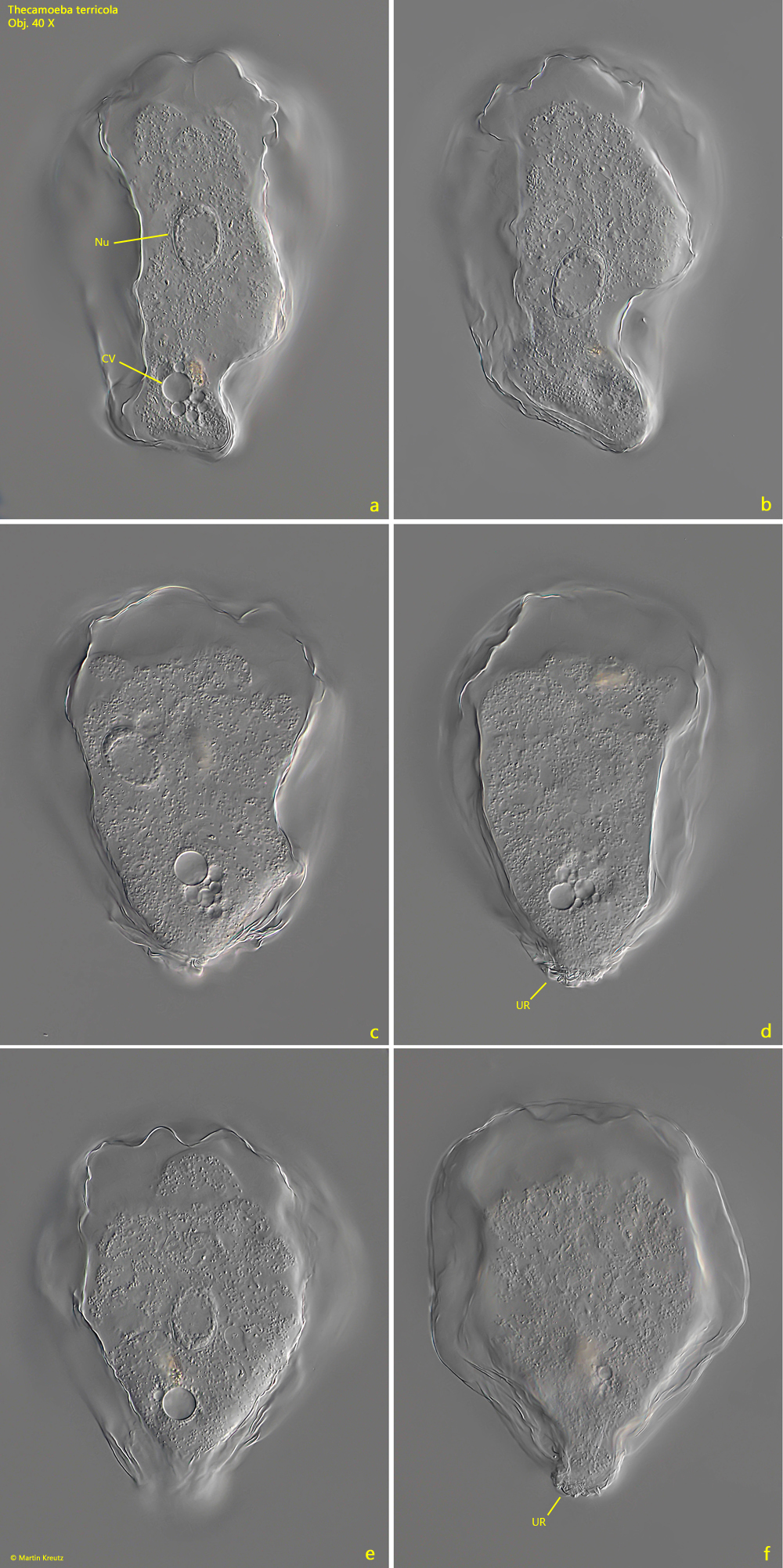
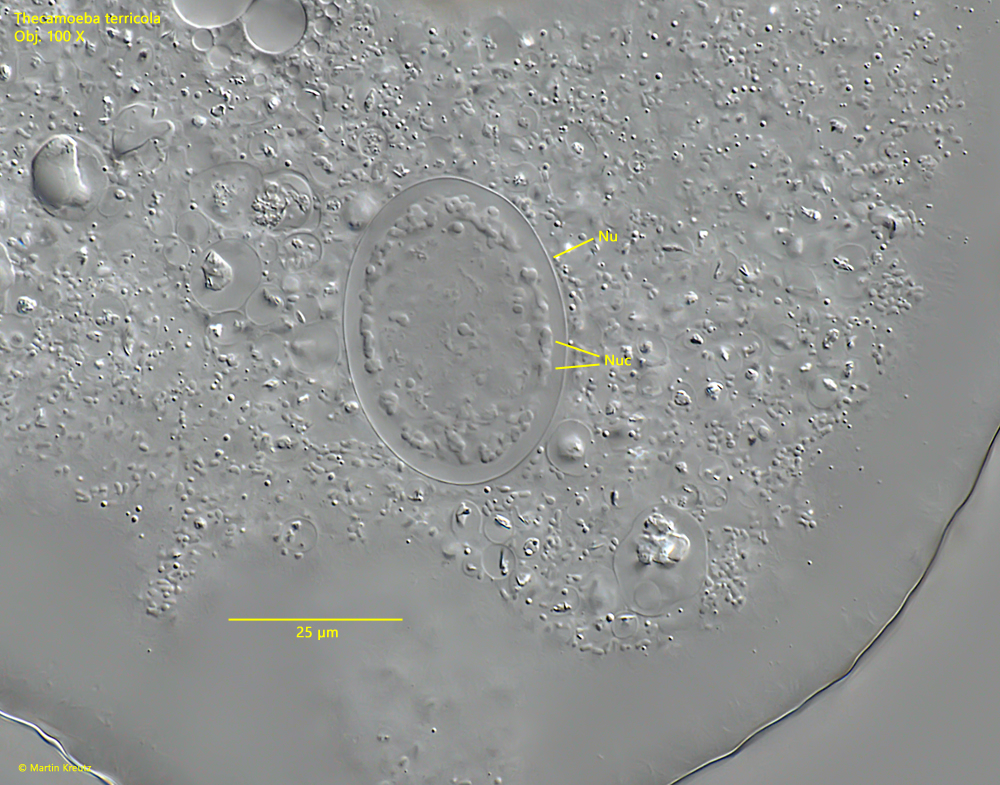
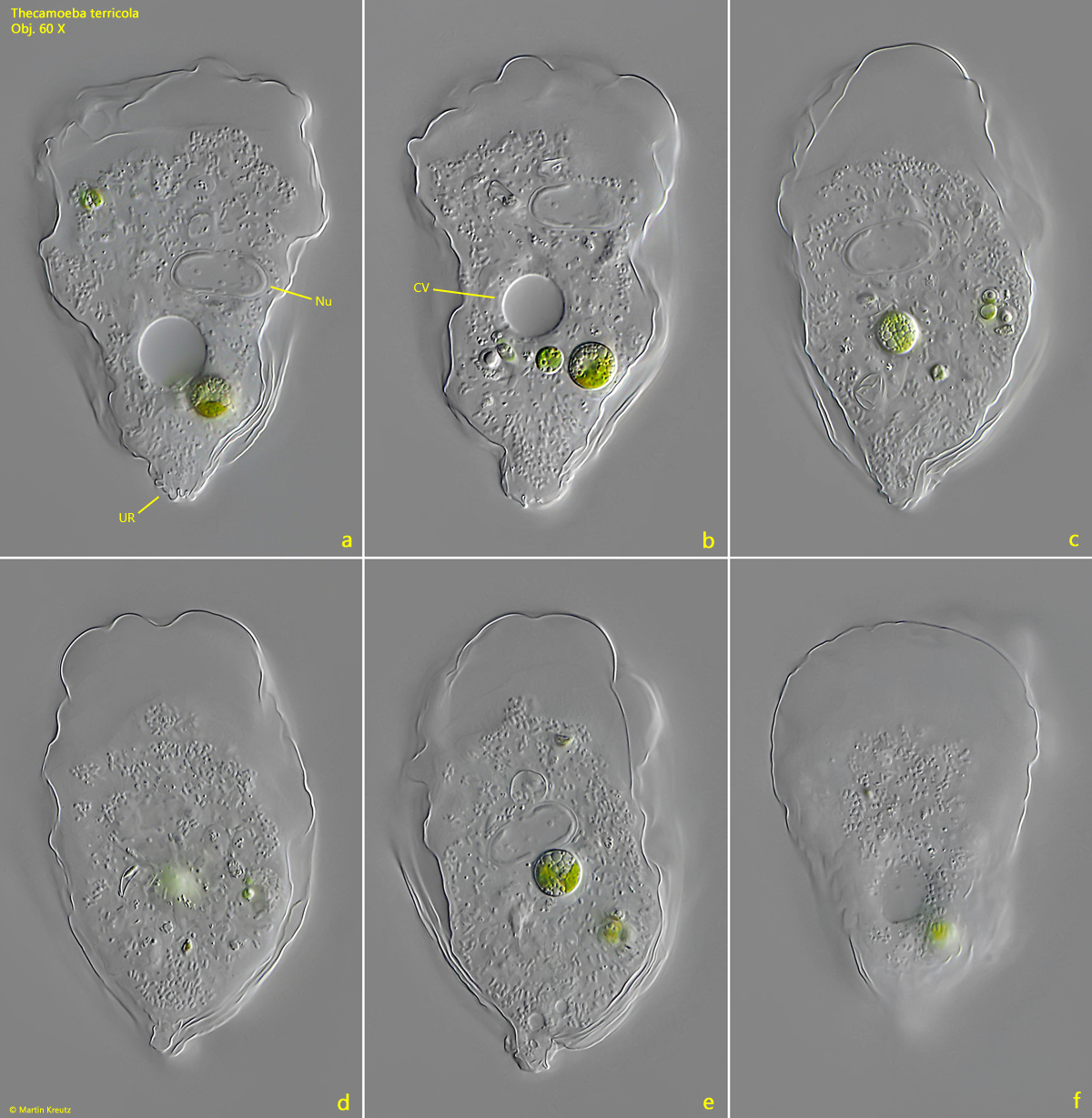
Thecamoeba terricola is one of the larger members of the genus Thecamoeba. In my population the specimens were mostly larger than 100 µm. The free-flowing form (s. figs. 1 a-f and 3 a-f) often shows a terminal uroid, which appears either strongly folded or short, knob-like protrusions. The surface shows no or inconspicuous longitudinal folds. An essential feature of Thecamoeba terricola is the ellipsoidal nucleus with a parietal nucleolus, which is either present in small pieces (s. fig. 2) or in cup-shaped pieces (s. fig. 4).
Fig. 1 a-f:Thecamoeba terricola. L = 190 µm. A free-flowing specimen. CV = contractile vacuole, Nu = nucleus, UR = uroid. Obj. 40 X.
Fig. 2:Thecamoeba terricola. The nucleus (Nu) of the specimen as shown in fig. 1 a-f with parietal arranged nucleoar bodies (Nuc). Obj. 100 X.
Fig. 3 a-f:Thecamoeba terricola. L = 100 µm. A second, smaller specimen. CV = contractile vacuole, Nu = nucleus, UR = uroid. Obj. 60 X.
Fig. 4:Thecamoeba terricola. L = 100 µm. The nucleus (Nu) of the specimen as shown in fig. 3 a-f with parietal arranged nucleoar bodies (Nuc). Obj. 100 X.