I regularly find Trachelomonas globularis f. punctata in the Simmelried, especially among floating plant masses. In older samples the specimens collect on the bottom of the containers.
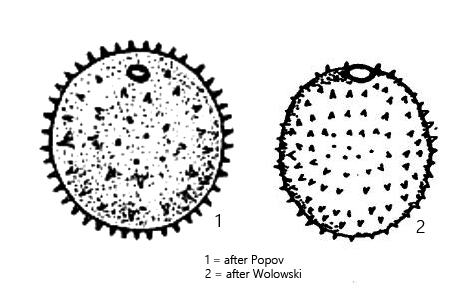
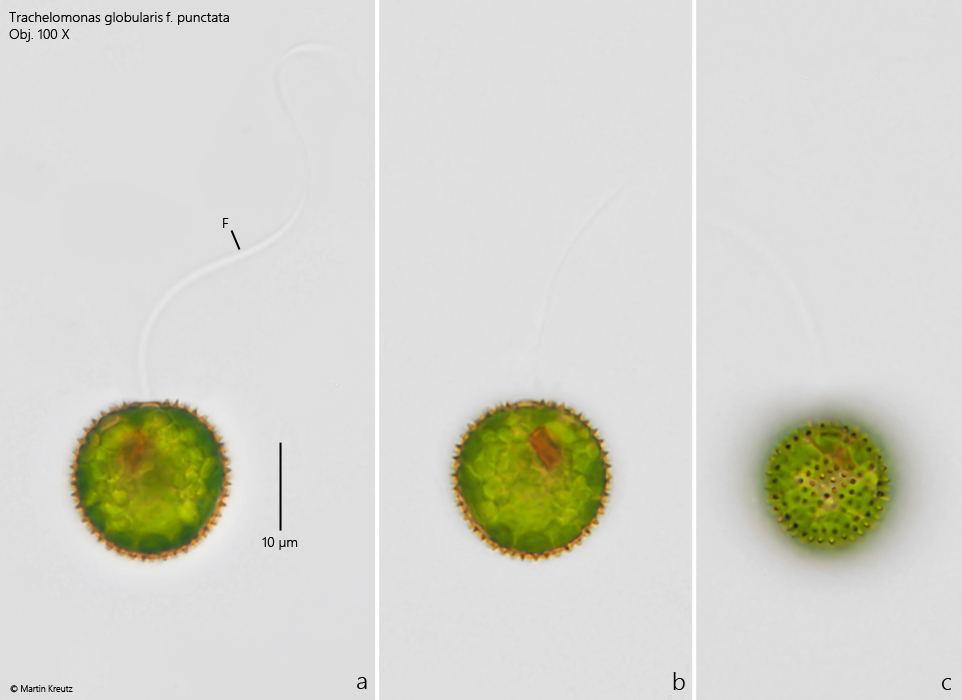
Trachelomonas globularis f. punctata is a small and inconspicuous species. Only at higher magnification can one see that the lorica is covered with spines about 1–2 µm long. These cover the entire lorica with the exception of the apical pore, which is surrounded by a slightly thickened rim. The eyespot in my specimens was very large and approximately rectangular (s. fig. 1 b). The diameter of the loricae in my specimens was 17–19 µm, which corresponds well to the data given by Popova (1966). The color of the lorica was clearly orange as well.
The similar species Trachelomonas bacillifera is covered with blunt, rod-shaped spines that are not pointed at the ends.
Fig. 1 a-c:Trachelomonas globularis f. punctata. D = 17.7 µm. Three focal planes of a freely swimming specimen in brightfield illumination. F = flagellum. Obj. 100 X.
Fig. 2 a-c:Trachelomonas globularis f. punctata. D = 17.7 µm. The same specimen as shown in fig. 1 a-c in DIC. Note the short spines covering the spherical lorica. Obj. 100 X.