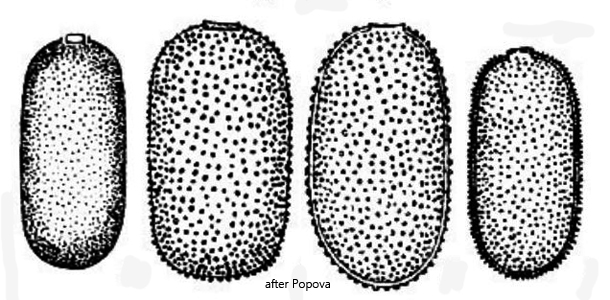
lorica densely punctate, sometimes with short papillae
several chloroplasts with pyrenoids
eyespot large
flagellum of body length
Trachelomonas lacustris
I find Trachelomonas lacustris only sporadically at Simmelried. So far, I have not been able to record this species at any of my other sites.
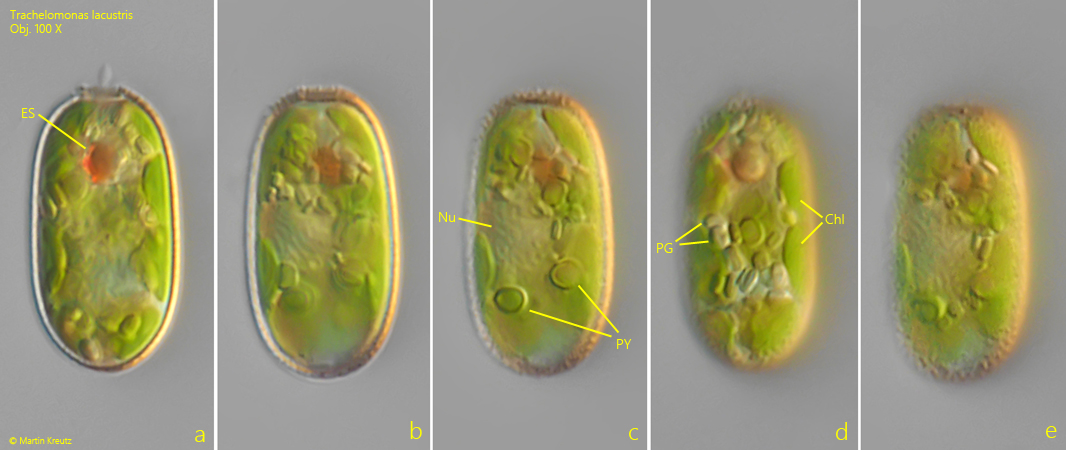
A characteristic feature of Trachelomonas lacustris is the punctate structure of the lorica, which bears no spines. A collar around the pore is not developed; at most, there is a thickening, but it is smooth. The lorica has a yellowish-brown color. Several disc-shaped chloroplasts are present, appressed to the lorica (s. fig. 1 d). Each chloroplast contains a pyrenoid (s. fig. 1 c). The paramylon grains are small and broadly oval or somewhat angular in shape (s. fig. 1 d). The nucleus is centrally located (s. fig. 1 c).
Fig. 1 a-e:Trachelomonas lacustris. L = 30 µm. Different focal planes of a specimen which has shed off the flagellum. Note the pyrenoids (PY) in the chloroplasts (Chl) and the punctate surface of the lorica (e). ES = eyespot, Nu = nucleus, PG = paramylon grains. Obj. 100 X