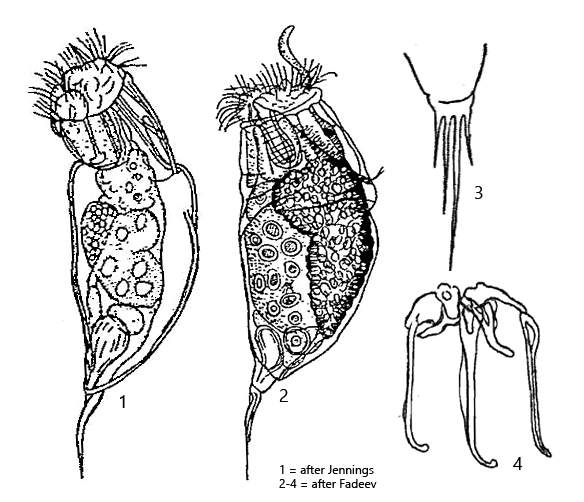
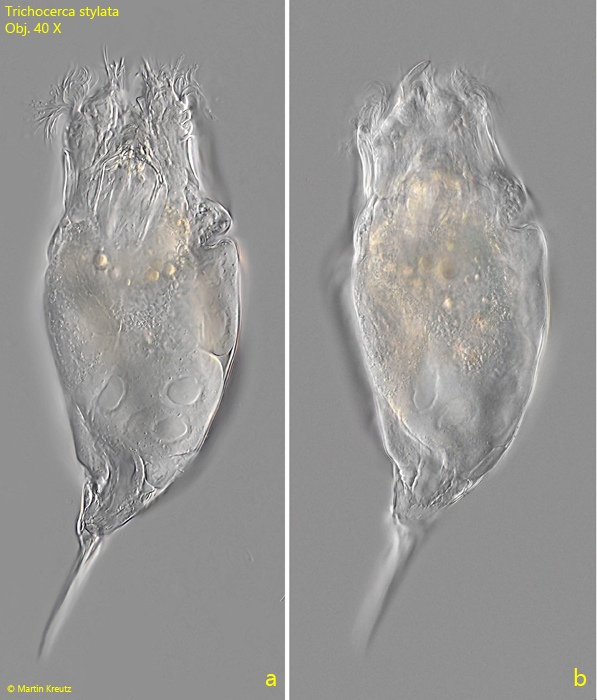
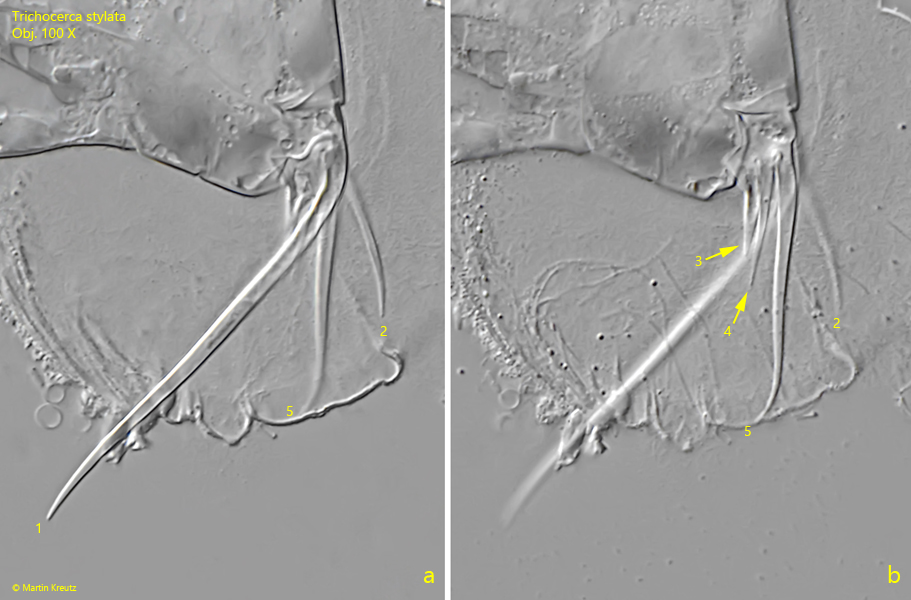
I have only found Trichocerca stylata a few times in the plankton from the pond of the waste disposal company Constance and in the Mühlhalden pond. With a length of over 200 µm, the specimens in the samples are striking. An important feature is the toes, which in my specimens reached a length of 45–52 µm, about a quarter to a fifth of the body length. They have a short, S-shaped course directly at the base of the foot, which then continues straight or only slightly curved towards the pointed end. Next to the left main toe, I was able to identify 4 additional secondary toes (s. fig. 5 a-b). This differs from the observations of Fadeev (1926), who drew three side toes (s. drawing 3 above).
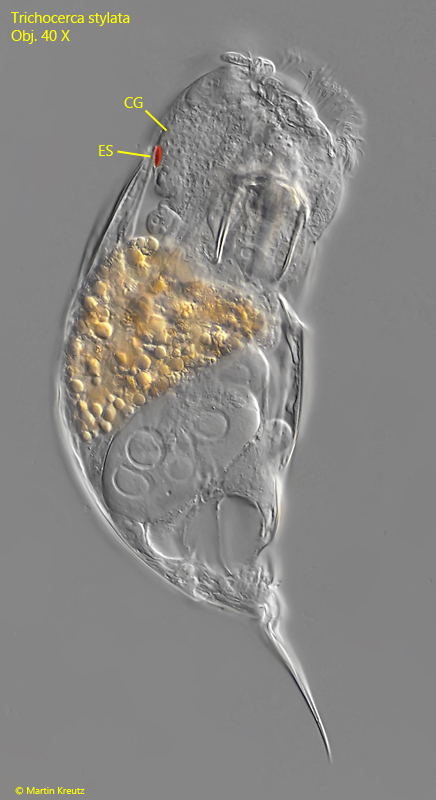
Another important characteristic of Trichocerca stylata is the position of the eyespot. It is located in the middle of the cerebral ganglion on the dorsal side (s. fig. 3). This is an important distinguishing feature from the similar species Trichocerca pusilla, whose eyespot is located at the end of the cerebral ganglion. Additionally, the toes of Trichocerca pusilla are about half as long as the body, and the total body length of Trichocerca pusilla is only 130 µm. In the pond of the waste disposal company Constance, both species appeared simultaneously in the summer of 2020, and I was able to distinguish the species well based on these characteristics.
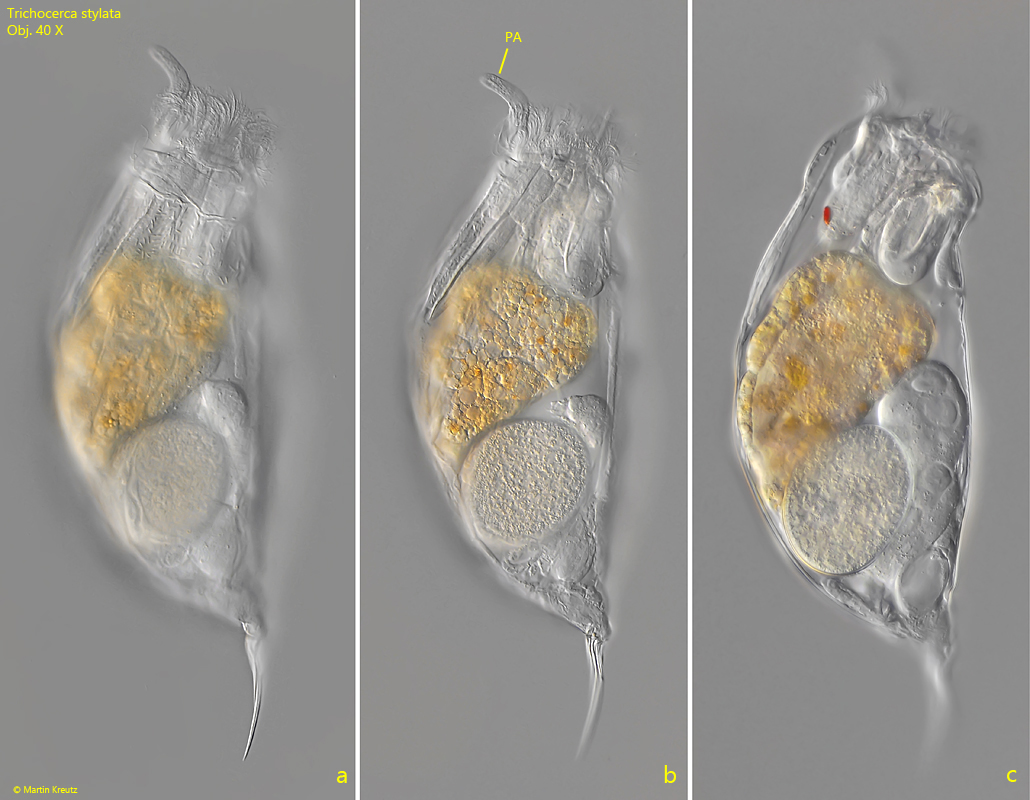
Fig. 2 a-c:Trichocerca stylata. L = 204 µm (incl. toes). A second freely swimming specimen found in November 2024 in the Mühlhalden pond. Note the slightly curved palp organ (PA). Obj. 40 X.
Fig. 3:Trichocerca stylata. L = 204 µm (incl. toes). The slightly squashed specimen as shown in fig. 2 a-c. The eyespot (ES) is located in the middle of the cerebral ganglion (CG) at the dorsal side. Obj. 40 X.
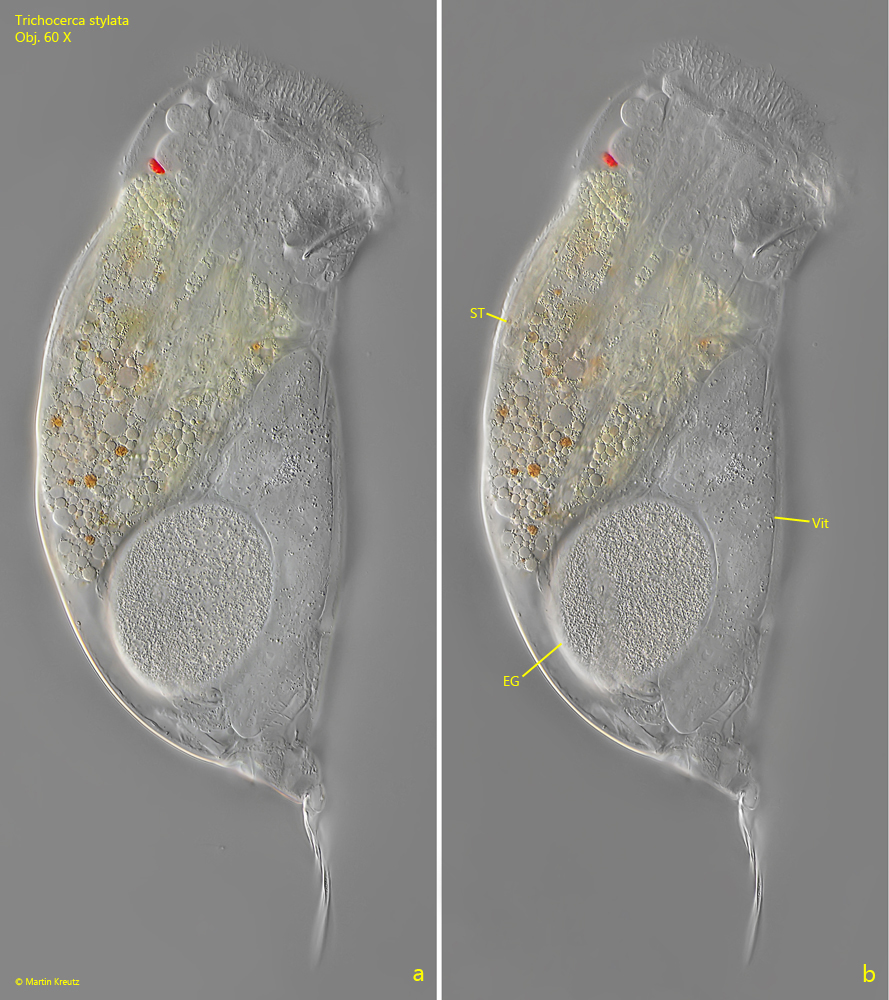
Fig. 4 a-b:Trichocerca stylata. Two slightly different focal planes of a squashed specimen from right. EG = egg, ST = stomach, Vit = vitellarium. Obj. 60 X.
Fig. 5 a-b:Trichocerca stylata. Two focal planes on the toes of a squashed specimen. Beside the main toe (1) with a length of 49 µm there are 4 additional seconary toes (2-5). Obj. 100 X.
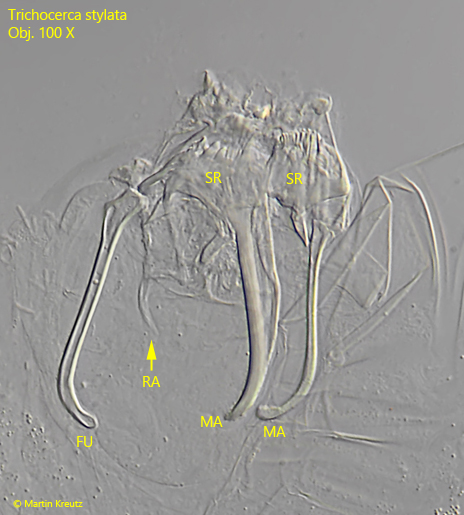
Fig. 6:Trichocerca stylata. The trophi in a strongly squashed specimen. FU = fulcrum, MA = manubria, RA = rami, SR = suprarami. Obj. 100 X.