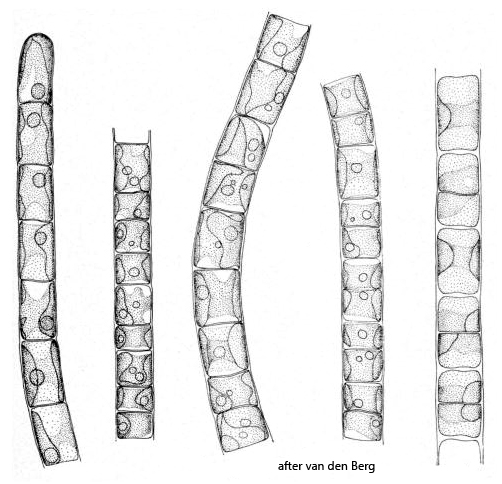
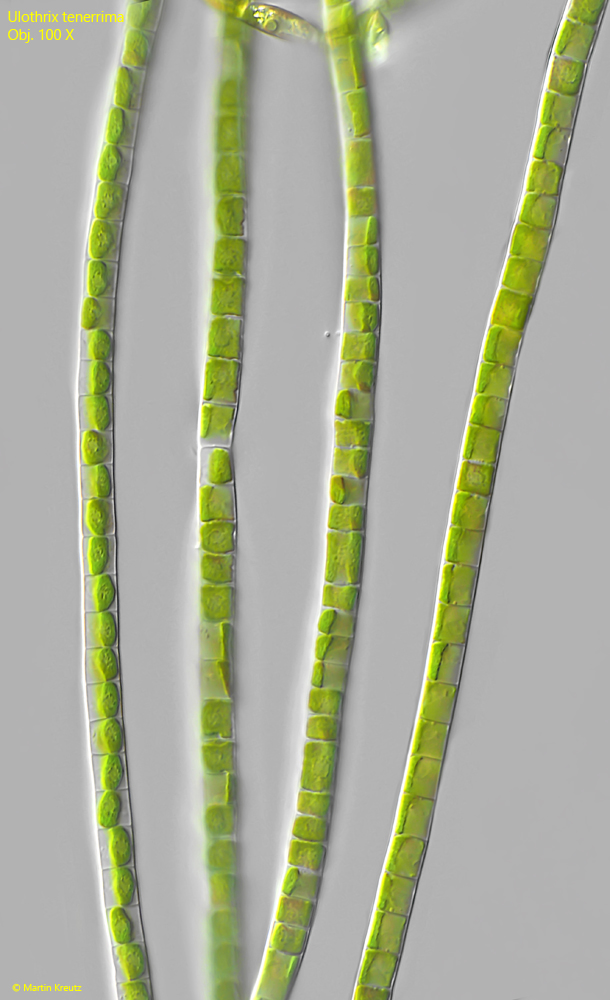
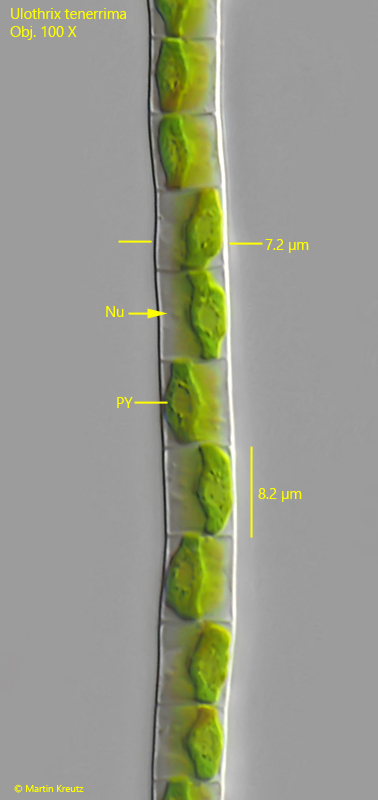
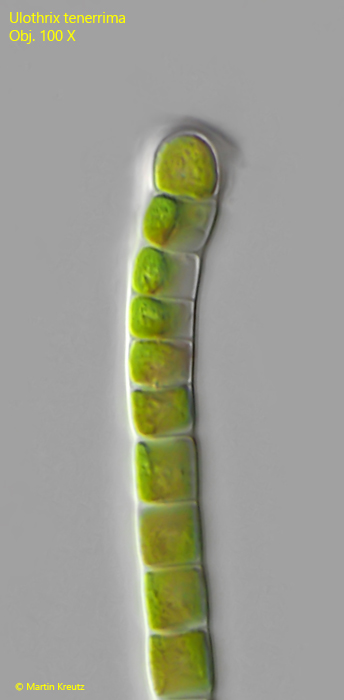
So far, I have only found Ulothrix tenerrima in the Paradieswiesen in Austria. The unbranched filaments of this alga stand out due to their plate-shaped chloroplast, which lies against the cylindrical cell wall but only covers about half of it. As a result, the chloroplast can also be seen in some filaments from the edge view. This is very characteristic of the genus Ulothrix. The following parameters are important for species identification.
– length and width of the cells – presence of constrictions at the cross walls – shape of the terminal cells – number of pyrenoids in the chloroplast – whether a gelatinous sheath is present
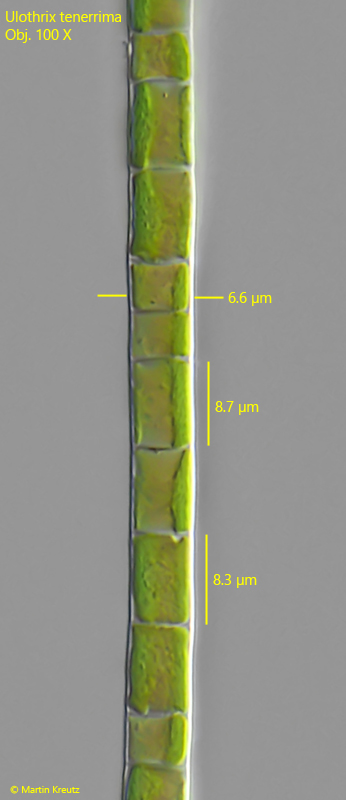
In my population, the cell filaments were 6–8 µm wide and the cells were between 7–9 µm long. There was always only one pyrenoid in the chloroplast. There were no or only very slight constrictions at the cross walls. A mucilaginous sheath around the filament was either absent or very thin. The end cells were apically rounded. These characteristics correspond to Ulothrix tenerrima.
Fig. 1:Ulothrix tenerrima. Overview with several straight filaments. Obj. 100 X.
Fig. 2:Ulothrix tenerrima. L = 7.8–8.7 µm (of cells). A filament of cylindrical cells with a diameter of 6.6 µm. There are no constrictions at the crosswalls. Obj. 100 X.
Fig. 3:Ulothrix tenerrima. A second filament with a diameter of 7.2 µm. Note the very small nucleus (Nu) and the single pyrenoid (PY) in the chloroplasts. Obj. 100 X.
Fig. 4:Ulothrix tenerrima. The rounded cell with a gelatinous cap at the end of a filament. Obj. 100 X.