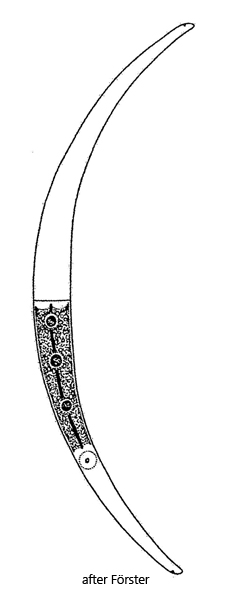
two chloroplasts, each with 3–5 longitudinal ridges
several pyrenoids arranged along cell axis
girdle bands absent
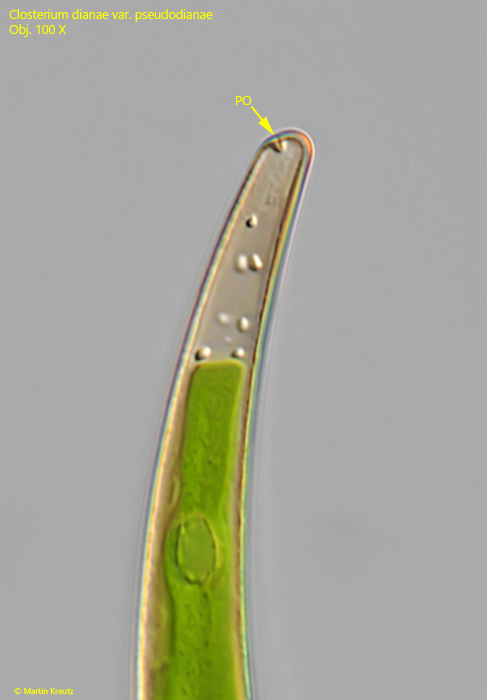
terminal vacuoles with several crystals
nucleus central
Closterium dianae var. pseudodianae
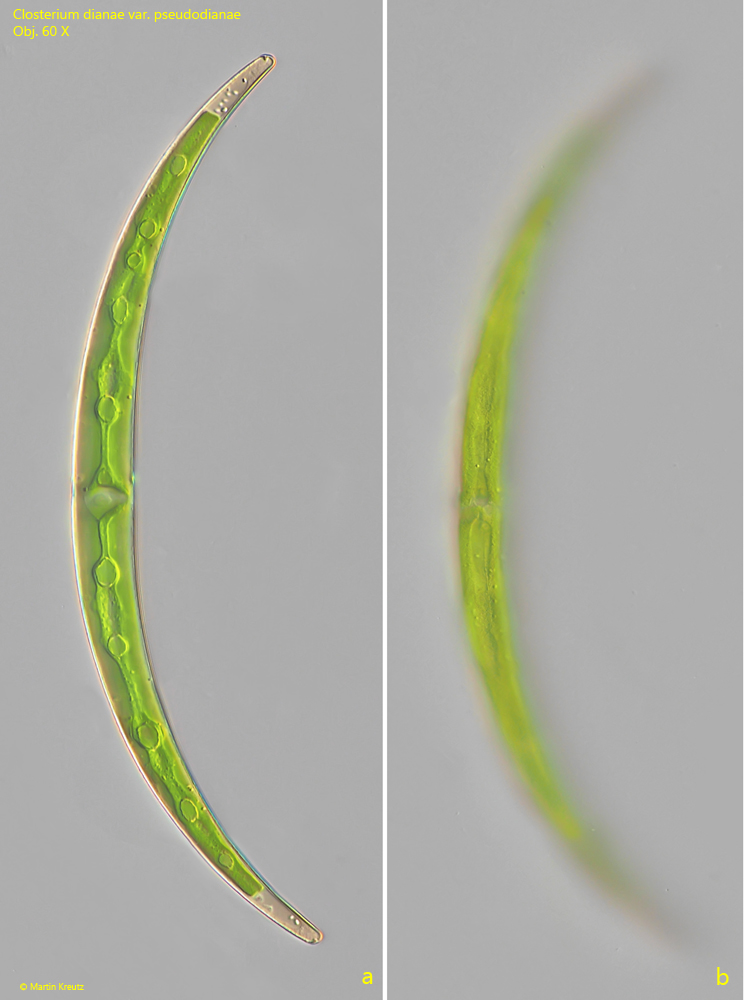
I found several specimens of Closterium dianae var. pseudodianae in an old sample from the Schwemm Moor. The cells are more slender and curved compared to the basic form Closterium dianae.
To distinguish it from the similar varieties Closterium dianae var. arcuatum and Closterium dianae var. minus, it is necessary to measure the length and width of the cells. Closterium dianae var. arcuatum is significantly longer at over 350 µm, and Closterium dianae var. minus is clearly smaller at under 150 µm in length. In addition, Closterium dianae var. arcuatum is also wider in the middle of the cell at 20–30 µm than Closterium dianae var. pseudodianae.
Closterium dianae var. pseudodianae has so far only been detected in Austria in Lake Neusiedl by Kusel & Fetzmann (1974). In Germany, the species has been found, for example, in the Harz National Park (Reinecke, 2022). In general, the species is considered rare.
Fig. 1 a-b: Closterium dianae var. pseudodianae. L = 242 µm. Two focal planes of a specimen found in the Schwemm Moor. In the middle the cell is 15 µm wide. Obj. 60 X.
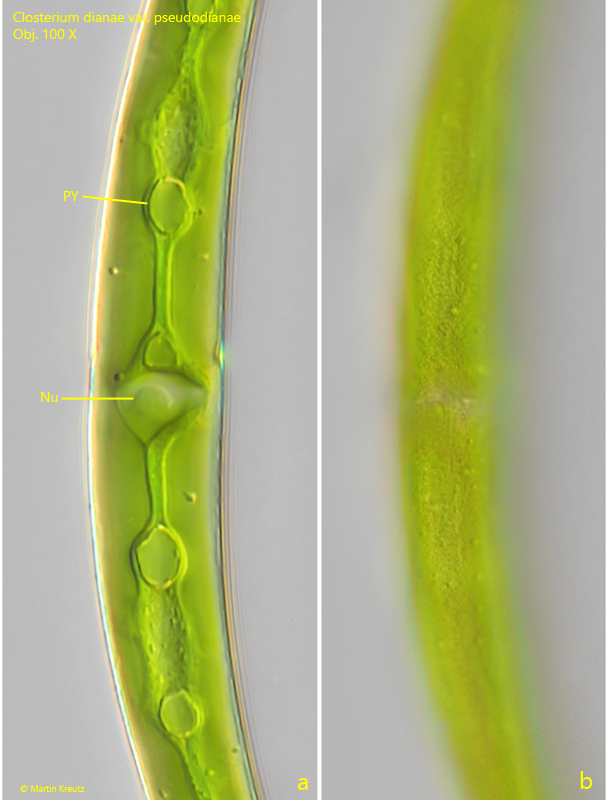
Fig. 2 a-b: Closterium dianae var. pseudodianae. L = 242 µm. Focal plane on the nucleus (Nu) and on the smooth cell wall. PY = pyrenoid. Obj. 100 X.
Fig. 3: Closterium dianae var. pseudodianae. The distinct porus (PO) of the apex. Obj. 100 X.