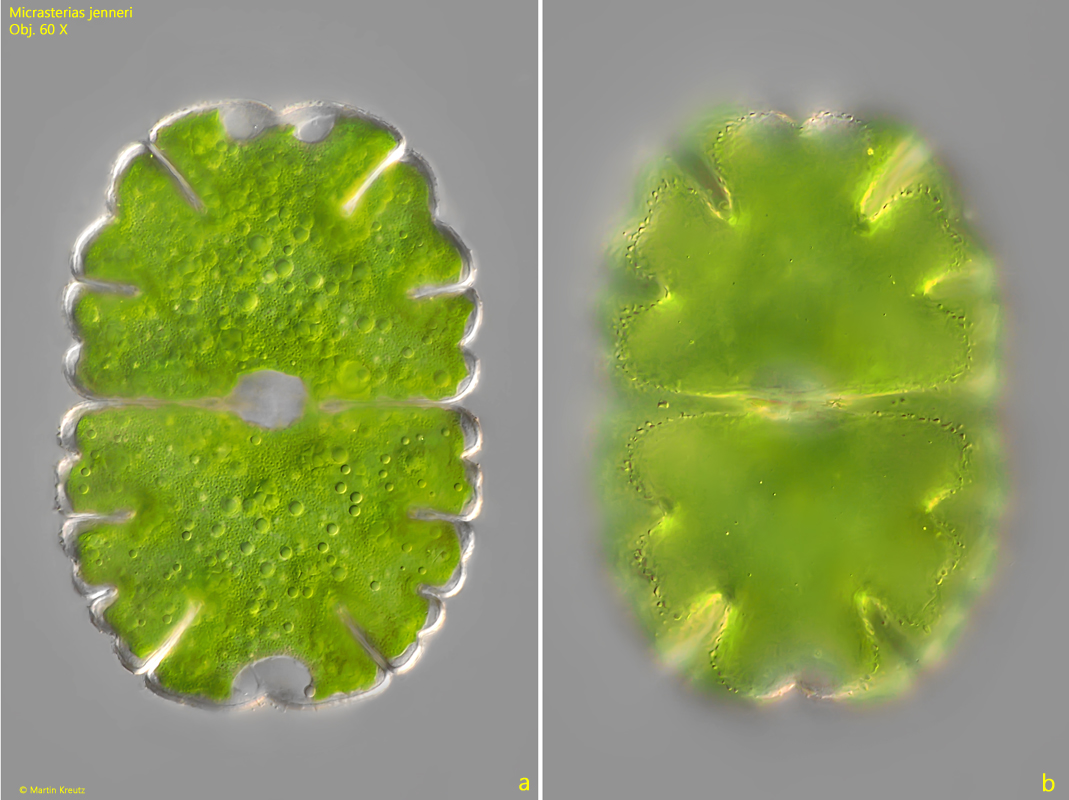
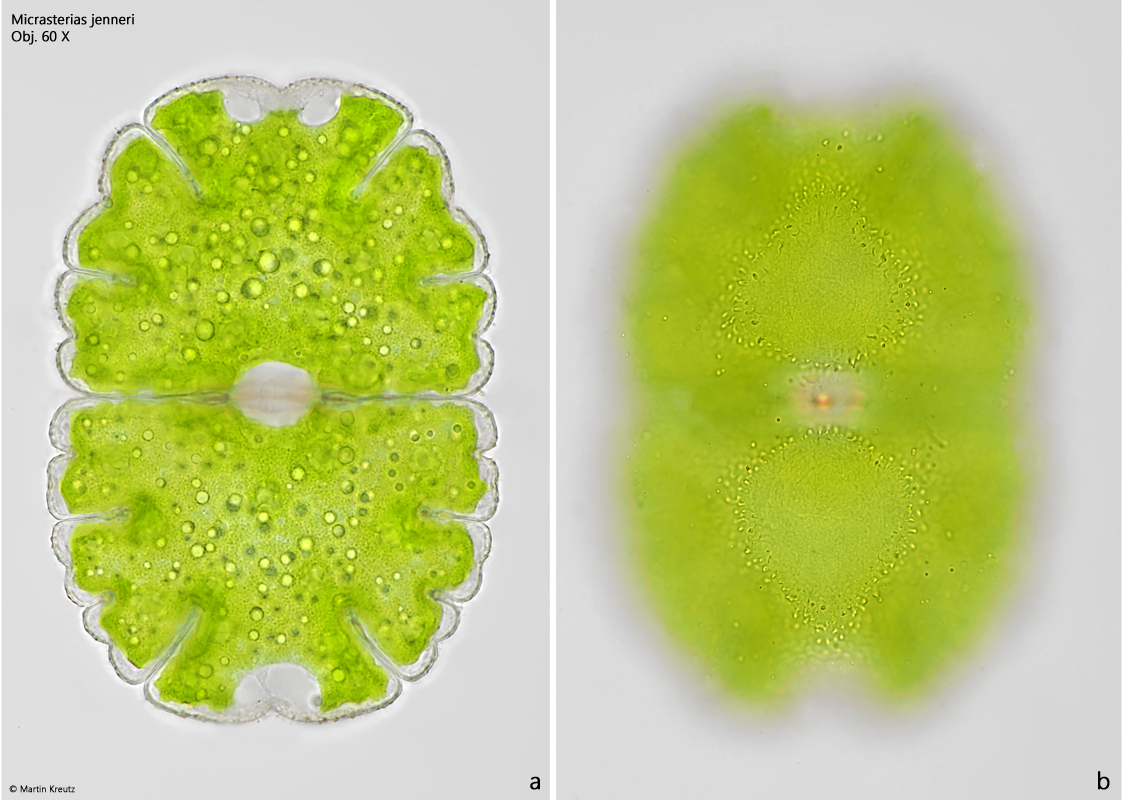
So far, I have found Micrasterias jenneri exclusively in Schwemm Moor in Austria. I found the first specimens in the years 2004 and 2025. The findings are remarkable in this respect because Lenzenweger writes in 1996: “from Austria there is so far only a single, rather dubious record from a waterhole on the Tauernhöhe at 1700m (Bock, 1960)”. It can be assumed that Lenzenweger also thoroughly investigated the Schwemm Moor. It is therefore possible that Micrasterias jenneri only occurs temporarily in the Schwemm Moor.
The shape of Micrasteria jenneri is somewhat reminiscent of Micrasterias denticulata. However, the latter species is considerably larger, is slightly waisted and above all has more lobes, which are cut twice by incisions. In Micrasterias jenneri, each lobe is only moderately incised once. The shape is therefore much simpler.
The few specimens I found were between 150–160 µm long. All specimens were densely filled with starch grains and oil droplets making the pyrenoids unrecognizable.
Fig. 1 a-b:Micrasterias jenneri. L = 156 µm. Two focal planes of a specimen found in the Schwemm Moor in June 2025. Obj. 60 X.
Fig. 2 a-b:Micrasterias jenneri. L = 156 µm. The same specimen as shown in fig. 1 a-b in brightfield illumination. Obj. 60 X.
Fig. 3:Micrasterias jenneri. A specimen found in July 2004 in darkfield illumination. Obj. 40 X.