eye spot without lens at posterior end of ganglion
retrocerebral organ present
stomach and intestine colored yellowish or orange
rami with three groups of teeth
Monommata maculata
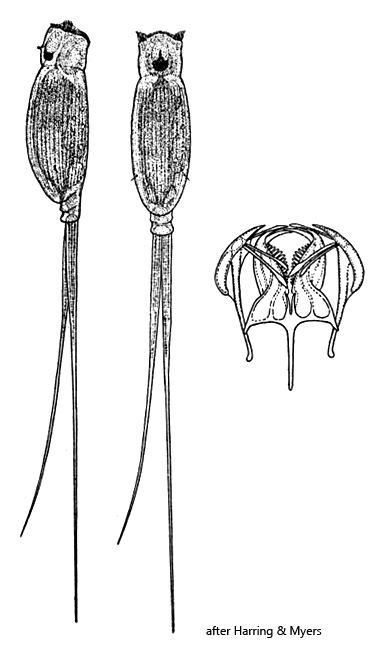
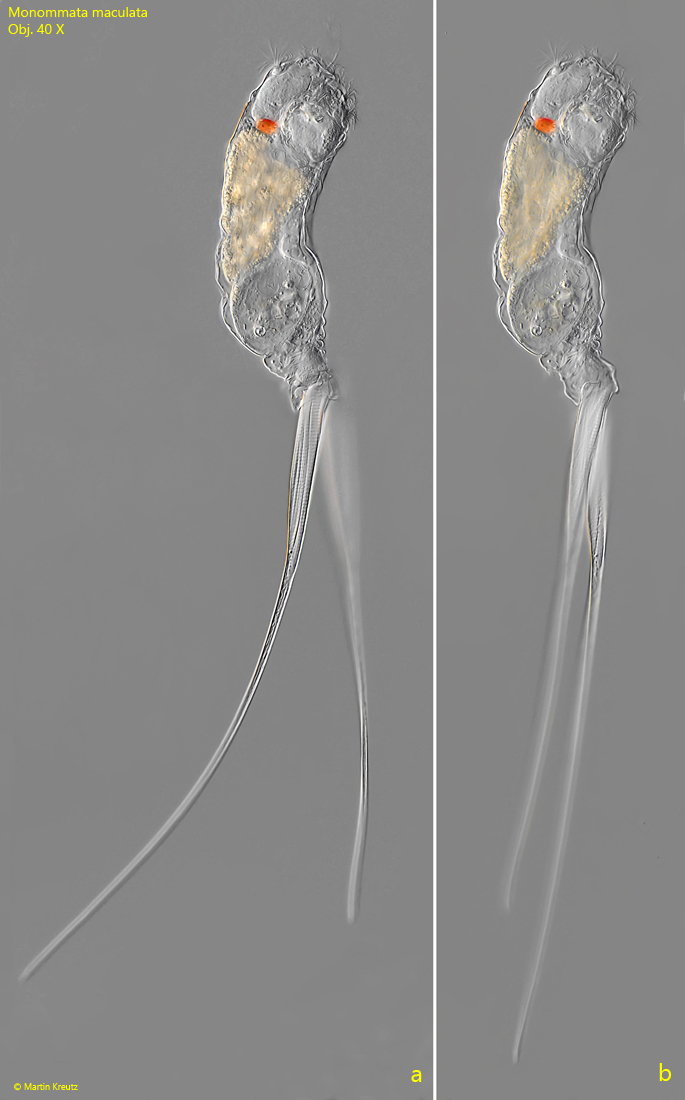
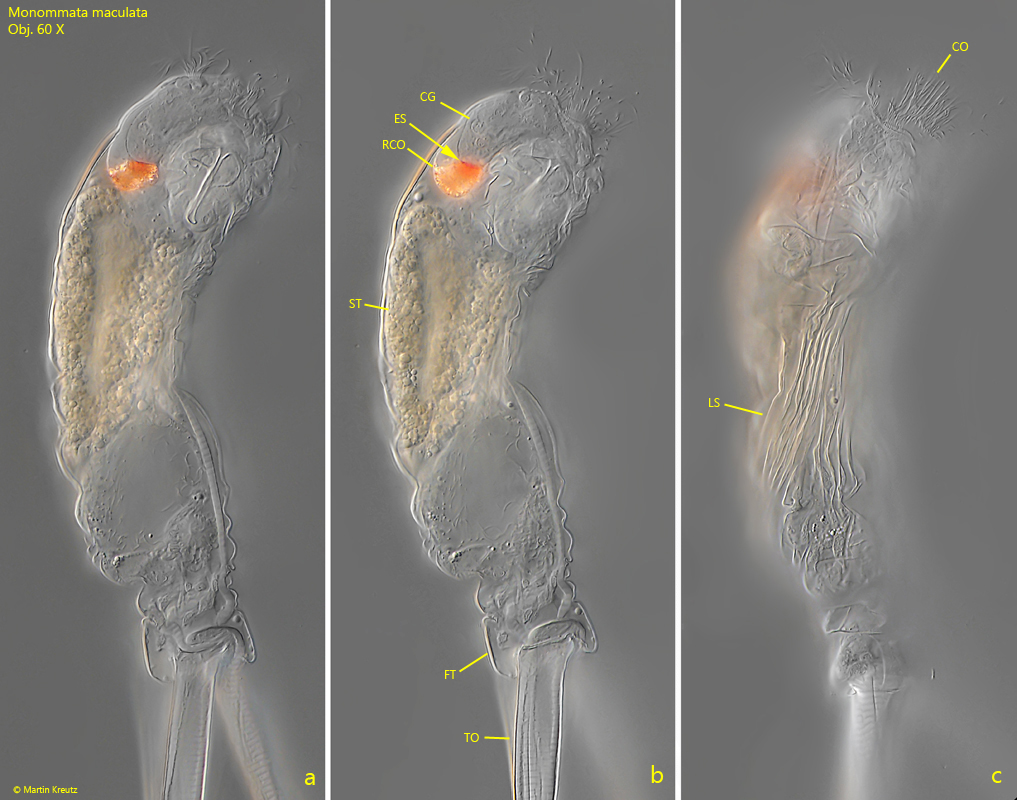
So far, I have only been able to find Monommata maculata in June 2024 in the Paradieswiesen in Austria. The species within the genus Monommata all look very similar externally. However, Monommata maculata has very long toes compared to its body. Additionally, beneath the eyespot, there is a retrocerebral organ, which in my population was orange-colored and contained fine crystals (s. fig. 2 b). Harring and Myers (1930) also described red spots at the level of the lateral antennae, which I could not detect. These spots were also not observed by Plewka (2025, link s. below).
A reliable distinction from other species within the genus Monommata is only possible based on the structure of the trophi. In Monommata maculata, the rami have distinct rows of teeth of different sizes. These are so pronounced that they can be recognized even in strongly squashed specimens in the trophi (s. fig. 3).
Fig. 1 a-b:Monommata maculata. L = 470 µm (with toes). A freely swimming specimen from right. The right toe has a length of 330 µm. Obj. 40 X.
Fig. 2 a-c:Monommata maculata. L = 470 µm (with toes). Three focal planes of the body. Note the plate-shaped red eyespot (ES) attached to the cerebral ganglion (CG). Below the eyespot the orange colored retrocerebral organ (RCO) is visible. FT = foot, LS = longitudinal striation of cuticle, ST = stomach, TO = toes. Obj. 60 X.
Fig. 3:Monommata maculata. The trophi in a strongly squashed specimen. Note the teeth of different size of the rami (RA). Obj. 100 X.