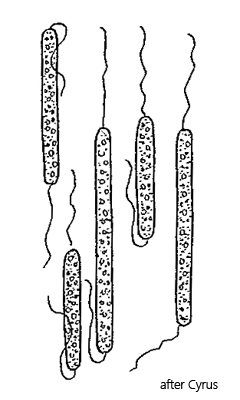
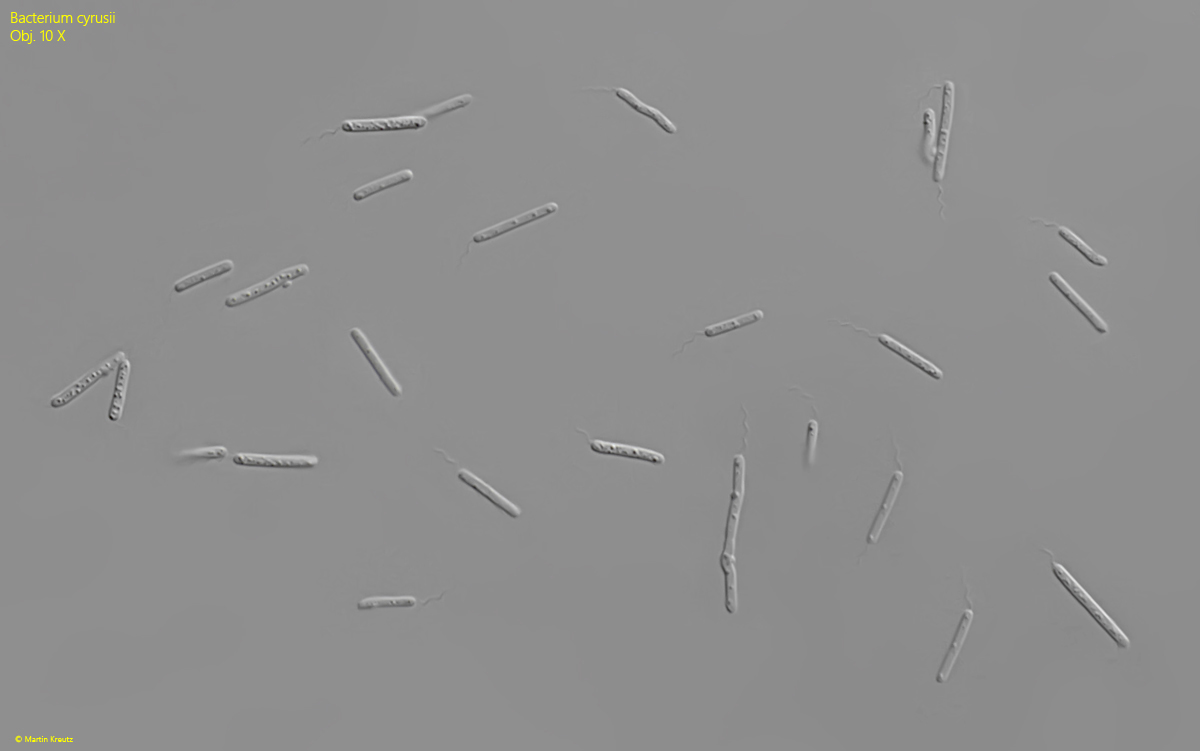
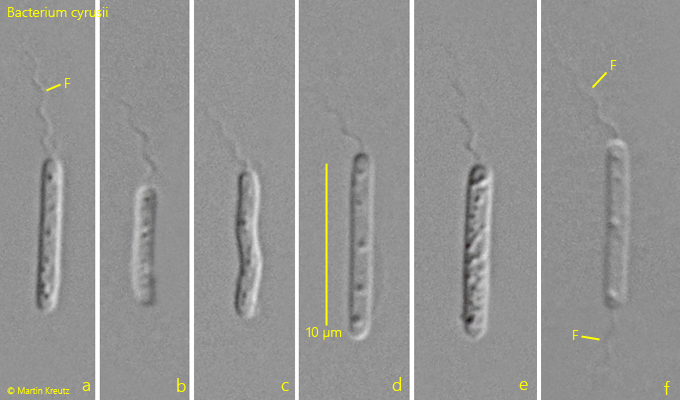
The cells of Bacterium cyrusii are straight rod-shaped with rounded ends. The cytoplasm is clearly granulated. At 7–14 µm in length, these are very large bacteria. This also makes it possible to see the flagellum under the light microscope, which is not possible with most bacteria (s. fig. 2 a-f). It is probably a bundle of flagella that appears under the light microscope as a single flagellum. In most specimens I could see only one flagellum, which may be because the second flagellum lies against the body when the bacterium swims in the direction of the active flagellum. Only in a few specimens could I see two flagella (s fig. 2 f).
The movement of Bacterium cyrusii, including the dynamics of its two flagella, was excellently documented by Ariel Qassis in a video:
In the video, it is clearly visible that only the flagellum in the direction of movement can be seen at any given time. The passive flagellum is folded against the body during this period and is almost invisible. When the direction is reversed, both flagella are briefly visible before the previously folded flagellum takes over propulsion. This dynamic was described by Cyrus (1969) and is typical for Bacterium cyrusii.
Fig. 1:Bacterium cyrusii. L = 6.8–19.4 µm. An agglomeration of several specimens. Obj. 100 X.
Fig. 2 a-f:Bacterium cyrusii. L = 6.8–11.8 µm. Some specimen in detail. The most specimens have one visible flagellum (F) but specimens with 2 visible flagella were also present (f). Obj. 100 X.